Search


28 Mar 2026
Search
28 Mar 2026

Please allow ads as they help fund our trusted local news content.
Kindly add us to your ad blocker whitelist.
If you want further access to Ireland's best local journalism, consider contributing and/or subscribing to our free daily Newsletter .
Support our mission and join our community now.
To continue reading this article, you can subscribe for as little as €0.50 per week which will also give you access to all of our premium content and archived articles!
Alternatively, you can pay €0.50 per article, capped at €1 per day.
Thank you for supporting Ireland's best local journalism!

Paul Flinter and his wife Trish Doyle from Carlow

Meet Paul Flinter and his wife Trish Doyle who are both from Carlow and have created a one-of-a-kind social group for people with aphasia.
Aphasia is an acquired language disorder which affects approximately a third of all stroke survivors, according to the Irish Heart Foundation.
Paul had a sudden brain haemorrhage and a stroke in May 2022, which resulted in the condition aphasia. He now finds it harder to communicate with people but his intelligence and personality is still the same.
"It just came on suddenly. There were no warning signs or anything like that. I just went up to bed and before I turned the lights off, I had a stroke," Paul said in an exclusive interview with Carlow Live.
READ NEXT: Carlow school to benefit from DEIS+ programme rolling out this September - Carlow Live
Trish added: "I was downstairs and I heard a movement upstairs and I went up and it was very clear at that stage, Paul was having a stroke.
"He lost the use in his right side and his speech was slurred, but he was able to communicate. We rang the ambulance and they said an ambulance would be there in 20 minutes.
"20 minutes later, I rang again and they said they had flagged it to a more urgent case. We waited almost two hours for an ambulance and by that stage, Paul got the use back in his leg and he was able to walk down the stairs."
Trish explained that while they were on the way to Kilkenny Hospital, Paul suffered a massive bleed on the brain.
"At that stage then, there wasn't much hope of him surviving it at that time. That night doctors said there was nothing they could do for it. They just had to wait and see. The next 24 hours were vital, whether he'd survive or not".
In their upcoming documentary Paul explained that Trish was told "he will be dead by the morning" by doctors.
Paul thankfully showed signs of recovery 48 hours later in the hospital.
"Paul doesn't remember, but he showed some signs of response so we were hopeful that then he would survive, you know, and he did," Trish said.
Paul said the last four and half years since having his stroke have changed his whole life completely, but added "well I'm still alive!"
He was wheelchair-bound for some time after his stroke and still doesn't have use of his right arm. But Paul can now walk and his speech has improved greatly.
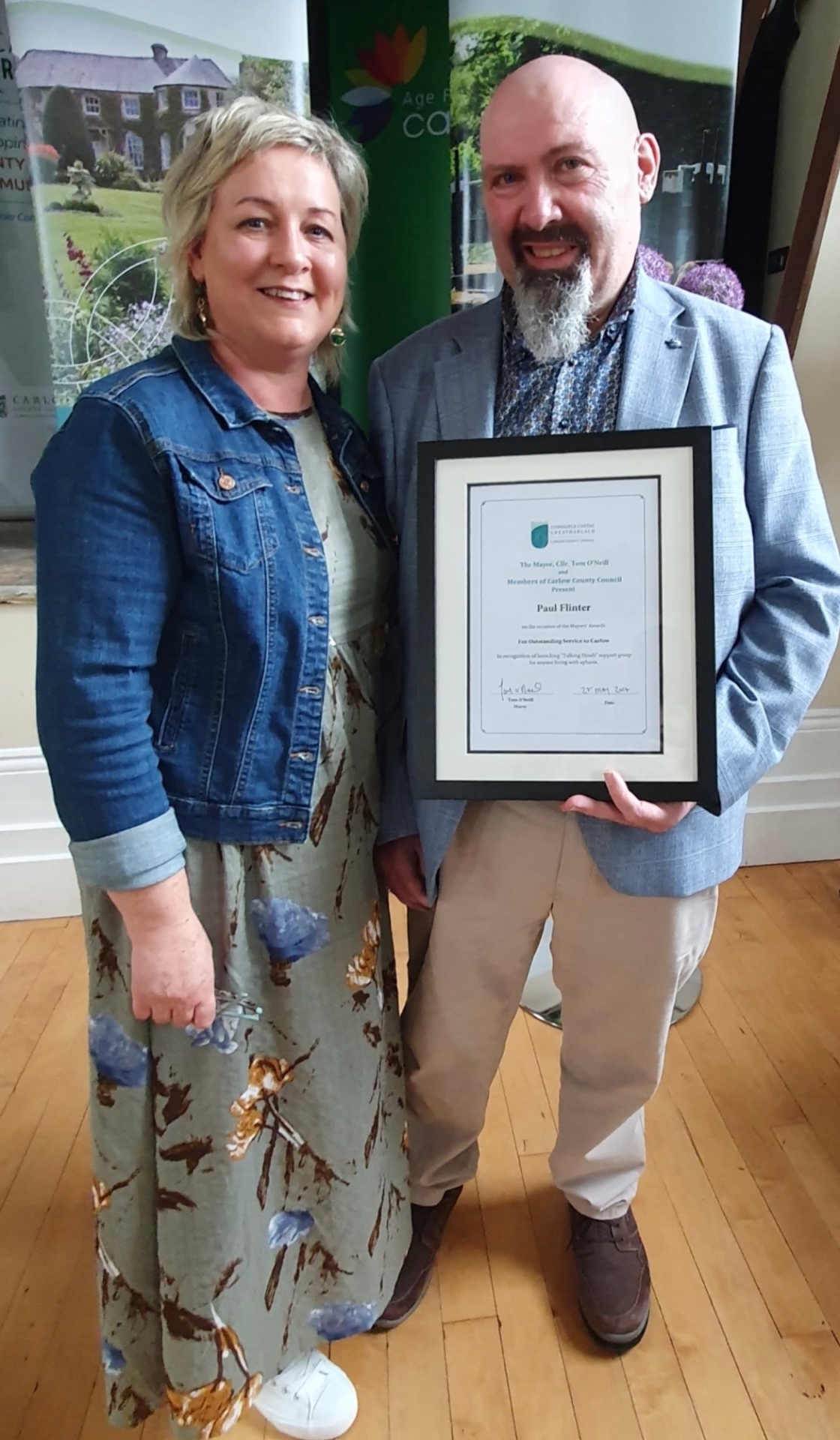
Pictured above is Trish Doyle and husband Paul Flinter
"My whole life has been turned upside down," Paul said. "We got no money to help us to make the decisions that I needed.
"Like, I couldn't walk and things like that. I couldn't speak. See, in the hospital, I showed some recovery so they decided, ah, that's good enough to go home. So they sent me home. But I wasn't home, because at home, I couldn't do anything".
Paul and Trish both agreed that there is very little support or services for stroke survivors and people living with aphasia in Carlow and in Ireland in general.
Trish said that initially they were told that Paul would be kept in Kilkenny Hospital for four months, and then transferred to the NRH in Dublin, which is a rehabilitation hospital.
But Paul recovered more quickly than expected, which is called a recovery spurt and was told he could instead go home.
"He was told now you're going home and you're going to a place in Carlow, which really isn't fit for purpose, not for someone of Paul's age and the intense rehabilitation that he needed at the time. The reason he was recovering so well was because he was getting intense rehabilitation.
"So it kind of defeats the purpose, doesn't it, if they kind of just tell somebody, you're going home because you're improving so well. We can't understand why then, if somebody is shown responding to rehabilitation so well, why they're not encouraged to stay there and to have the best recovery that they can".
Trish said that her and Paul have met many people who suffered strokes who were treated the same way.
Trish said that there is no speech therapy services in Carlow for stroke survivors and that she has had great difficulty in trying to find one at all.
"We just found out recently that the one speech therapist who was there in Carlow has resigned and it doesn't look like they're going to employ anybody in the near future. So that's very, very disappointing.
"It's completely disheartening. You know, people after a stroke, and especially with aphasia, they're trying so hard to recover and the first few years are vital in their recovery and rehabilitation.
"But, I mean, if there's no service providers, how are they going to do that on their own? Or sent home to somebody, carers like myself, that have no experience in these roles, but we're supposed to know how to do everything".
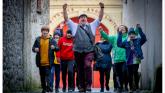
Trish and Paul set up a social group for stroke survivors who have aphasia called Talking Heads, pictured below, which now has 14 members.
The group meets up fortnightly to allow the members a safe space to talk to each other, play games and get out of the house.
The group is the first of its kind, according to Trish, and they have been working on a documentary that will be playing in The Visual in Carlow very soon.
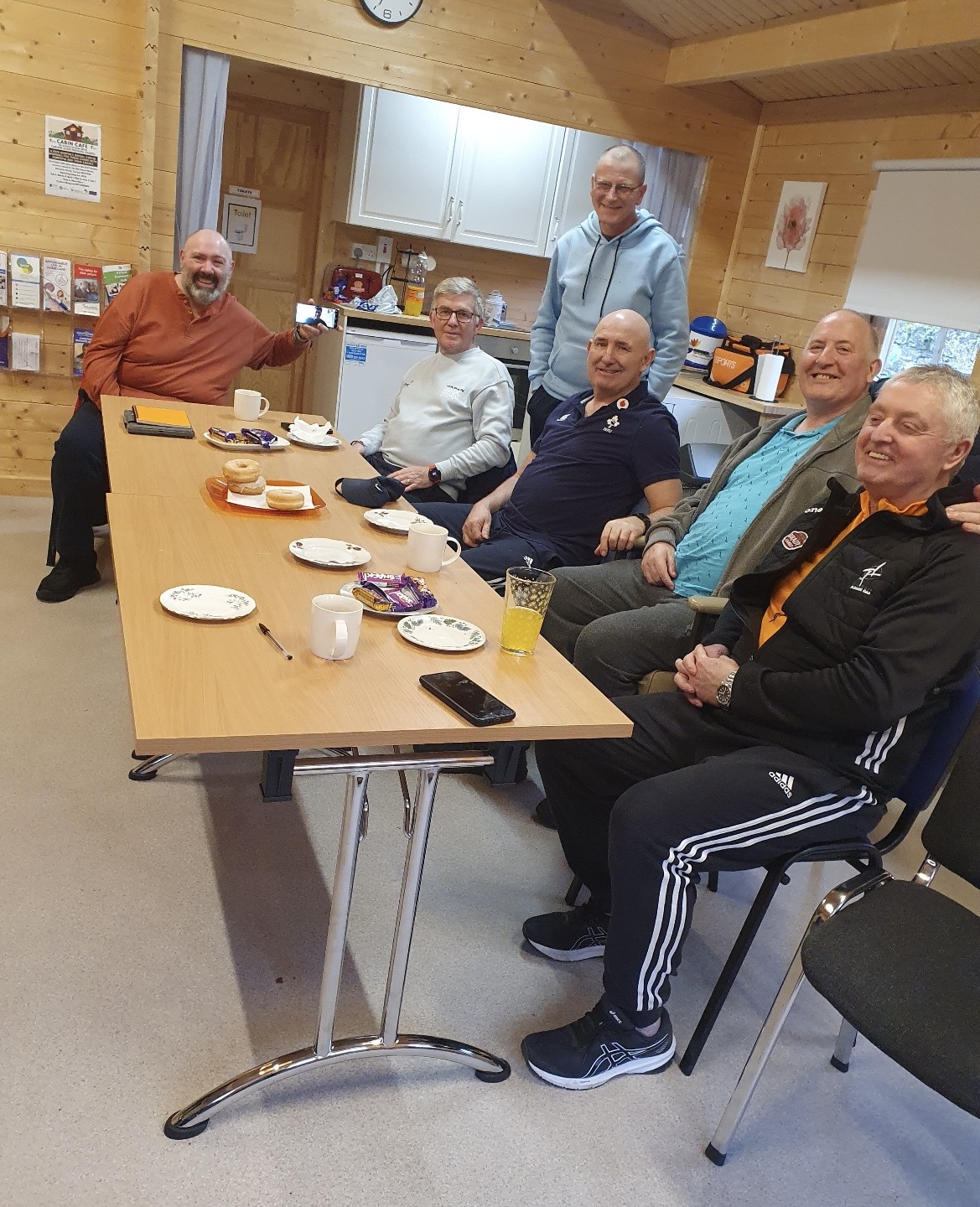
Pictured above is Paul and The Talking Heads group in Carlow
Paul said that in the group "some days, all you want to do is talk to each other. We have time to paint and play a few games on the PC.
"We set it up because there's nothing in Carlow for people like us to go. Sometimes it'll take 10 minutes or 20 minutes to say what you need to say.
"And there's only certain things your wife or your husband is able to do but if you're with other people like you, you can say what you need to say".
Trish explained that often times people stray away from talking to Paul because of his difficulty with communication.
Paul said simple things like going into a shop people would often look to Trish if he asks them a question.
"Simple little things like saying I want like a Kit-Kat. Like, a few years ago, I couldn't say something like that. But people, instead of taking the time for me, they go for somebody else. Can you explain what this person is thinking? This makes me very angry".
"In that case," Trish said, "what I would do is I would avert my gaze to Paul. So, they would have to then look at Paul and not to look at me. Because he was the one asking the questions".
The Talking Heads group in Carlow is very important to Paul and the members in helping to work on their social skills, speech and confidence overall.
"It's not good enough that there's no services. I mean, what do you do? Paul is the type of person that doesn't sit around. He never was before his stroke and he certainly hasn't done it since his stroke.
"He has been as active and proactive as humanly possible with all his defects, you know, he does strive every single day to improve whatever he can improve.
"Paul still doesn't have the use in his right arm. He would have some mobility problems, like we don't use a wheelchair anymore. He was wheelchair-bound in the beginning, but now he's walking and talking. Your speech has come on amazingly," Trish said.
All of the members of The Talking Heads group have been working on a documentary called Unspoken Voices. It will be shown in The Visual on April 26. Tickets are €7 and can be found on their website or bought at the door.
"So they've spoken and told about their stories about how aphasia affects their lives. It also features group meetings, it's not all doom and gloom, it really isn't, because the group, actually, we have some crack and we wanted to show people that don't have aphasia primarily what aphasia is but also, very importantly, to highlight the fact that the people that have aphasia, it doesn't affect their intelligence.
"It's a cognitive, comprehension disorder. It's not an intelligence disability. All the intelligence is there, they're still the same people".
Some of the money raised from the documentary will be going towards helping the group secure a speech therapist. They found a woman in Waterford but unfortunately they don't have the funding at the moment.
To anyone who would like to join or contact the group Talking Heads, you can email pflinter@gmail.com or call 086 3895757.

Subscribe or register today to discover more from DonegalLive.ie
Buy the e-paper of the Donegal Democrat, Donegal People's Press, Donegal Post and Inish Times here for instant access to Donegal's premier news titles.
Keep up with the latest news from Donegal with our daily newsletter featuring the most important stories of the day delivered to your inbox every evening at 5pm.
Follow us on


This publication supports the work of the Press Council of Ireland and Office of the Press Ombudsman, and our staff operate within the Code of Practice of the Press Council. You can obtain a copy of the Code, or contact the Council, at www.presscouncil.ie, Lo-call 1800 208 080 or email: info@presscouncil.ie.