
Difficult for EU to reach agreement to impose sanctions on Israel – EC president
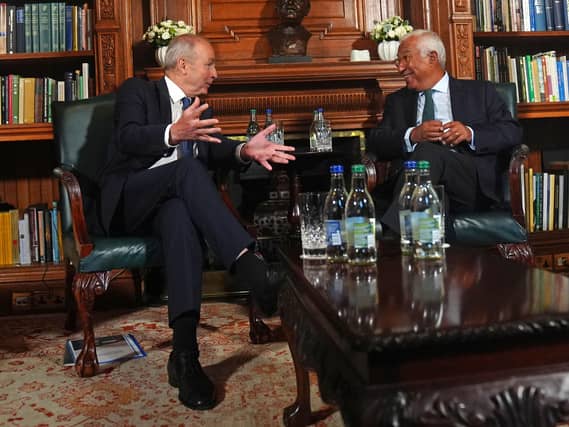

European Council president Antonio Costa said he hopes Israel will respect international law ‘as soon as possible’.
It is “difficult” to reach an agreement to impose trade sanctions against Israel, because EU countries have different histories and cultures, the president of the European Council said during a visit to Dublin.
Antonio Costa said he hopes Israel will respect international law “as soon as possible”.
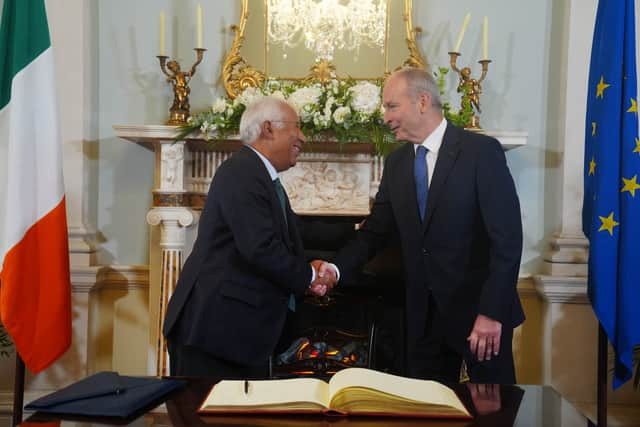
Mr Costa met with Taoiseach Micheál Martin in Dublin on Thursday to discuss negotiations ahead of the signing of the bloc’s seven-year budget.
Ireland has long pushed for a review of the EU-Israel Association Agreement, however other EU countries have opposed any plan to impose restrictions on goods from illegal Israeli settlements.
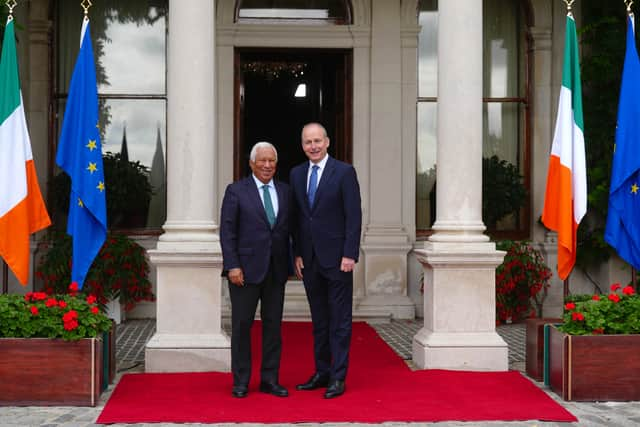
Mr Martin said that Ireland favours and supports the suspension of the Israeli trade agreement, but said there are “considerable differences of opinion” across the European spectrum.
“There always has been in respect to the Middle Eastern question and particularly the Palestinian-Israeli question,” Mr Martin added.
“Except that all of Europe supports a two-state solution, I think there is no question that the Israeli government’s behaviour in the Middle East, particularly in Gaza, and indeed in the West Bank, has been quite shocking from a humanitarian perspective.
“We have, along with other member states, sought a suspension, but there is not a critical mass as things stand. It seems to us we continue to pursue it with other member states, but that critical mass does not seem to exist for a suspension of the trade agreement. ”
Mr Costa said the EU needs to be “consistent in our values when we talk about international law” regarding multilateralism.
“Sometimes it’s difficult to find an agreement between the 27s, because we are looking at the world from a different regional point of view, with different histories, different cultures, and sometimes it’s not easy,” Mr Costa added.
“But what is important, that the 27 agree in the basic issues that just and lasting peace in the Middle East depends only on the two-state solution. The large part of the member states has already recognised Palestine.
“Everybody supported Israel after the terrible attack, the 7th of October, and everybody recognised the right of Israel to self-defence, but everybody also agreed to ask Israel to stop the aggression in Gaza, to respect the territorial integrity and sovereignty of Lebanon, and especially to stop the illegal settlements in the West Bank.
“Then, in spite of all the difference, we agree in the basic principles regarding our relationship with Israel, and we hope that Israel respects the international law as soon as possible.”
Meanwhile, Mr Martin also welcomed Canadian Prime Minister Mark Carney’s address to the European Parliament on Thursday.
It comes after European Commission president Ursula von der Leyen proposed making Canada the EU’s first associate member on Wednesday.
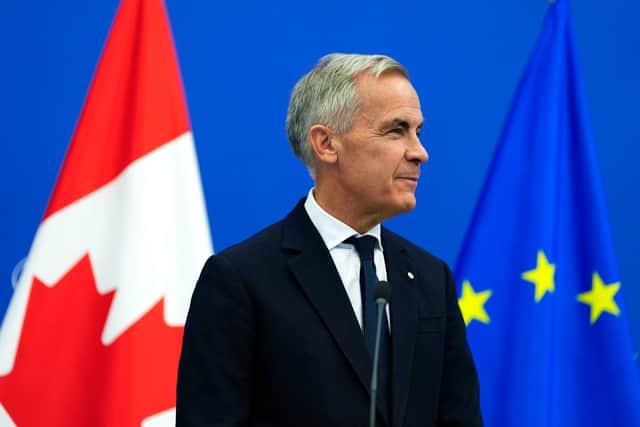
Mr Martin said that during his discussions with Mr Carney, he made it “very clear” that he was “pivoting” to Europe strategically.
“Of course, our trading relationship with Canada goes back, I think, to 2017, when the CETA trade deal was provisionally introduced, and it’s been a very positive trade agreement between Europe and Canada,” Mr Martin added.
“In fact, for Ireland, our exports increased four to five times since the introduction of CETA, and indeed our embassy in Canada produced an economic evaluation of the benefits as a result of the introduction of CETA, and so we think we are ready, and I think Europe is ready in terms of that has already developed a trading relationship, but I think what you’re looking at now is closer cooperation.
“There will be a fleshing out of the concept of an association agreement, but fundamentally, what you’re witnessing here is a closer, closer alignment of values and cooperation.”
Ms von der Leyen proposed making Canada the EU’s first associate member – a status that does not currently exist in the bloc’s treaties and would have to be created.
Mr Costa said that in these “uncertain and challenging” times, people are looking to the EU as a “reliable and predictable” partner.
“Especially with Canada. It is a like-minded partner, and effectively we have both parts a very good experience with our trade agreement,” he added.
“Canada wants to do more with us, and we want to do more with Canada.
“I think we can build with Canada the closest relation as possible between the European Union and Canada, and we are working on this.
“I’m looking forward with great expectation the upcoming EU-Canada Summit later this later this year, because it would be a very important moment.”