
Dozens of defendants granted criminal legal aid at least 20 times in 2025


Committee members will be told the reforms address structural weakness in the per-appearance model.
Some 150 people received criminal legal aid at least 20 times each last year, the Department of Justice has found.
The figure is expected to be presented to the Oireachtas Justice Committee as evidence for the necessity of reforms to the criminal legal aid scheme.
Justice Minister Jim O’Callaghan will appear before the Committee on Tuesday, where he is expected to commit to engaging with the Law Society in advance of a judicial review determination on the legality of his reforms.
He is also expected to defend the measures as “evidence-based” and “the most significant reform and modernisation” of the District Court criminal legal aid system in many years.
Committee members will be told the reforms address structural weakness in the per-appearance model and provide greater accountability on expenditure.
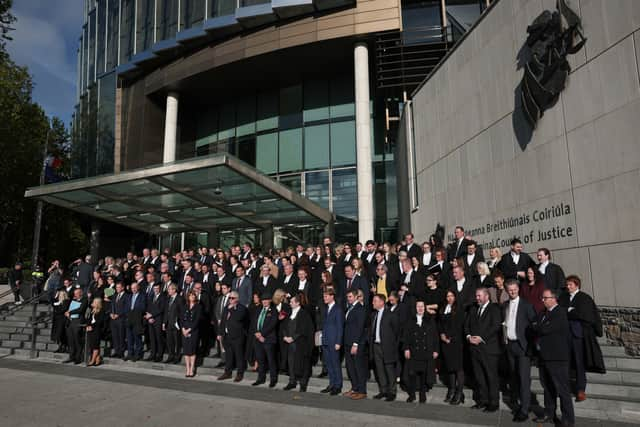
Solicitors escalated their long-running dispute with Mr O’Callaghan on Monday, withdrawing most services in court in protest over the changes to how they are paid under the scheme.

Earlier this year, Mr O’Callaghan introduced a 520-euro flat fee for criminal legal aid cases – which is designed to be equivalent to five appearances, which was the average, under the old scheme plus an 8% increase in fees given to all criminal lawyers.
Under the old system, solicitors were given 240 euro for a first appearance with a legal aid client and 60 euro thereafter.
Striking solicitors have rejected the new flat-fee model and have requested further engagement with the Department of Justice.
Mr O’Callaghan is expected to tell the committee that 177 solicitors are participating in the scheme across the country and that his department will continue to monitor its operation to ensure it is fair, transparent and suitable.
He will say that a review of the per-appearance scheme found there were more appearances and longer trials, multiple certificates being granted for no stated reason, and multiple solicitors assigned to the same defendant for charges heard on the same day.
The committee will be told that approximately 100,000 certificates were assigned to roughly 38,000 separate individuals – including 900 who had received it 10 or more times, and 150 who had received it on at least 20 occasions.
The minister is expected to say that 25% of certificates issued in 2025 were multiple certificates for cases heard together.
He will also provide examples of multiple certificates for one defendant accused of money laundering – including 131 heard across two appearances in the district court which the minister will tell the committee could result in fees of 26,800 euro as well as fees when the case was moved to the circuit court.
Another accused facing sexual offences in Cork had 112 certificates granted, the minister will say, and eight district court appearances – amounting to a potential 63,200 euro and the circuit court fee.
Mr O’Callaghan will argue that his reforms shift the focus from certificate numbers to case progression, case management and case resolution.
He will say the changes are delivering a more efficient system and easing the administrative burden of managing the scheme.
Mr O’Callaghan will also brief the committee on his engagement with the Law Society, where he is expected to outline that he has already made concessions.
These include an increase in the flat fee from 455 euro to 520 euro, the withdrawal of the proposed payment of 100 euro for cases sent forward for trial following concerns raised during the consultation process, the retention of payments for photocopying, travel and subsistence expenses, and splitting the payment of the fee into two instalments.
Mr O’Callaghan has previously indicated that he is awaiting the determination of a judicial review in the High Court on the legality of the reforms before engaging in further mediation.
Critics of the new scheme argue that a determination that the reforms are legal would not be a benchmark for its appropriateness.
The Law Society has said the High Court itself has urged the parties involved in the judicial review of the Criminal Legal Aid Scheme to resolve the matter outside court.
The minister is now expected to say that the determination remains important but that he will continue engagement with the Law Society in advance of the judgment.