
Public sector staff could be part of weeks-long rolling strike action


A 24-hour national walkout is proposed for next Thursday.
Significant numbers of public sector staff who work in key areas could be part of weeks-long strike action on a rolling rotation, as unions seek to step up their industrial action.
Trade unions and Government officials are holding further talks on Wednesday with an independent body to resolve the long-running dispute over public sector pay.
Union members are preparing for a 24-hour national walkout on the same day as a major EU presidency event.
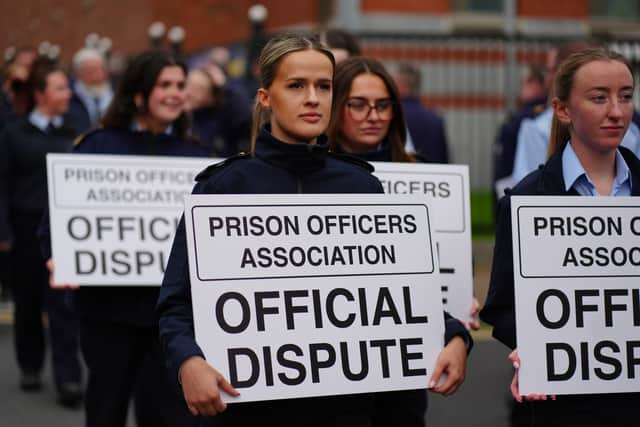
On Monday, unions announced the strike would instead be on Thursday November 12, which will coincide with the largest event of Ireland’s presidency of the Council of the European Union.
The European Political Community (EPC) summit will see around 50 heads of state and leaders of other international bodies visit Dublin.
A rank-and-file Garda work-to-rule is also planned in the days around the event in a dispute over their working conditions.
Unions have accused the Government of making a pay offer that is not credible.
Kevin Callinan, general secretary of Forsa, and chair of the Irish Congress and Trade Union’s Public Service Committee, said that the first increase in the proposal from Government was a 1.75% rise from November 1.
There would then be a pay increase of 6.75% with an additional 1% for local bargaining, Mr Callinan said on Wednesday.
He said that with inflation running at 4.1%, that offer would have been “wiped out” quickly in the lifetime of the proposed agreement.
Asked what the next steps are after next week’s strike, Mr Callinan told RTÉ Radio 1 that various things are under consideration.
“I don’t think that we’ll have another nationwide one-day strike, but there are various sectoral actions under consideration,” he added.
“Possibly stoppages, possibly other things. In my own union, we’re looking at the option of deploying our strike fund to take out sections of our members for a week and make up their wages.
“We could do that for very significant numbers in key areas if we have to.
“We could rotate it week by week. Maybe 1,000 members here one week, 1,000 members in another place the following week.”
Asked what he wanted from the Government’s pay offer, he said: “To be honest, comparing apples with apples, is probably more like 7%.
“We wanted to protect members against the effect of inflation during this year, where we have inflation running at 4.1%, and we wanted to protect members against prices over the duration of an agreement.
“The Government side have proposed a 30-month agreement so that it would run until the end of 2028.
“What they have proposed, when you consider the fact that this took place against a very serious dispute, a strike on October 14, very clear messages from our members about what they required, we believe that the offer that was put is not credible.”
He said the Workplace Relations Commission have a “strong idea” in relation to how the dispute will be resolved.
“This is this is a very complex set of discussions. There are a number of elements in play that would affect the figure, depending on whether or not they can form part of an overall agreement, we’re still in a process,” he added.
“Out of respect to that, I’m not going to put a figure on it.
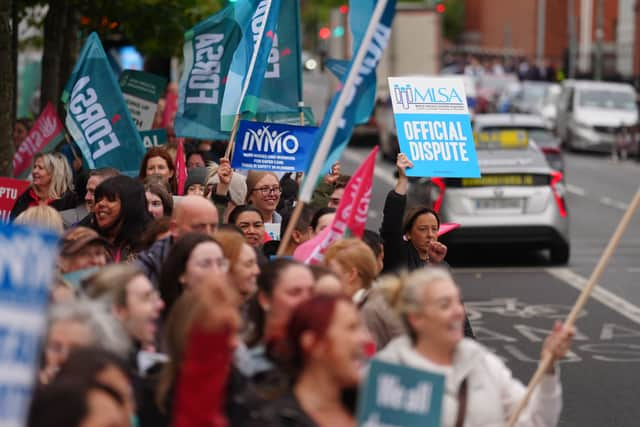
“We need the Government to hear, not just listen, but hear what our members said on the picket lines.
“I think it’s very disappointing that when I spoke to Minister Chambers after the strike, he had indicated to me that they wanted to respond to what they’d heard to do a fair deal.
“What we have now is not a fair deal. I met with over 200 branch representatives in my own union yesterday. They are absolutely resolute.
“There is a lot of quiet determination to see this through, whatever it takes, even beyond the planned strike for next week.”
Unions have said the EU event was not intentionally targeted and the date change was “more driven by logistical considerations” and a desire to vary from the last national strike which was on a Wednesday.
Hundreds of thousands of public sector workers participated in that nationwide walkout, which saw impacts including the closure of schools, the rescheduling of thousands of non-emergency hospital appointments, and the cancellation of driving tests and most court hearings.
Mr Callinan said the initial proposal was to have the second day of strike action on a Wednesday, however issues were raised in relation to job sharing and the impact it would have on schools.
This, he said, led them to move the day of action to next Thursday, adding that there is “a lot of anger” towards the Government.